Birds
Bush Birds
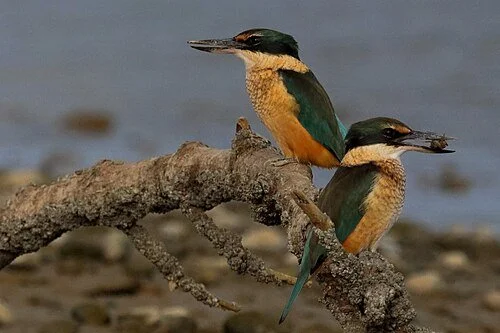
Native bush birds occur along the full length of the Pūharakeknui/Styx River corridor utilising native revegetation sites, willow-dominated riparian woodlands, and other types of exotic tree/shrub cover. The three most abundant species are tauhou/silvereye (Zosterops lateralis), pīwakawaka/South Island fantail (Rhipidura fulginosa) and riroriro/grey warbler (Geregone igata), which all have resident breeding populations that are augmented in autumn/winter by an influx of birds from habitats elsewhere.
Pīpīwharauroa/shining cuckoo (Chrysococcyx lucidus) are a spring/summer migrant, laying their eggs in the nests of riroriro "foster parents". These birds are found mainly in stands of willow, eucalypt and some of the taller native plantings, such as at Styx Mill Conservation Reserve. This species leaves Aotearoa in April and migrates to wintering areas on islands in the South-West Pacific. Another cuckoo, the koekoeā/long-tailed cuckoo (Eudynamys taitensis) are a rare visitor to the Pūharakeknui/Styx catchment, having been recently been recorded in the Lower Styx Road area near Spencerville. It is also a spring/summer migrant.
Increases in the local abundance and range of two native species, korimako/bellbird (Anthornis melanura) and kererū/New Zealand pigeon (Hemiphaga novaeseelandiae) have been evident over the last decade. Korimako were absent until the mid 1990s, but now occur along the full length of the Pūharakeknui/Styx River from Harewood to Brooklands. They are present year-round in some sites and have almost certainly now established as a resident-breeding species, rather than just a winter visitor (as was their status from the mid 1990s to about 2007). Kererū regularly occur (probably as seasonal visitors) in the Brooklands area along the lower reaches of the Pūharakeknui/Styx, and are occasionally seen further upstream, including the Styx Mill Basin area.
Birds of prey in the Pūharakeknui/Styx catchment number three species - the introduced and quite common little owl (Athene noctua), as well as the ubiquitous kahu/Australian harrier (Circus approximans) and a very small number of kārearea/New Zealand falcon (Falco novaeseelandiae). Over the last few years kārearea have been regularly sighted in the area between Lower Styx Road, Waitikiri Golf Course, and Bottle Lake Forest.
Quality habitats such as native bush plantings, mixed exotic/native woodland, and exotic plantation have great potential for native bush birds. Although not currently present, species such as pīpipi/brown creeper (Mohoua novaeseelandiae), miromiro/South Island tomtit (Petroica macrocephala), tūī (Prosthemadera novaeseelandiae), ruru/morepork (Ninox novaeseelandiae), and buff weka (Gallirallus australis hectori) would all likely do well if released into suitable habitats within the Pūharakeknui/Styx catchment in coming years.
A wide range of introduced birds occur along the Pūharakeknui/Styx River, including several species of ornithological interest. The Australian crested pigeon (Geophaps lophotes) may be establishing in the upper part of the catchment, particularly in the Gardiner's Road area. Groups of up to 6 birds have been sighted regularly, and although these birds have almost certainly escaped from captivity (rather than flown across from Australia). If breeding is proven, it will be the first confirmed instance anywhere in Aotearoa. Another pigeon, the barbary dove (Streptopelia roseogrisea) appears to have established a small population at the other end of the catchment in the Burwood - Brooklands area. The Pūharakeknui/Styx catchment therefore has the distinction of being one of the few areas in Aotearoa where four species of pigeon occur (kererū, Australian crested pigeon, barbary dove and rock pigeon).
Introduced gamebirds that utilise farmland and woodland habitats also utilise the catchment. They include pheasant (Phasians colchicus), California quail (Callipepla californica), peafowl (Pavo cristatus) and the rare cirl bunting (Emberiza cirlus).
Wetland Birds
Today the Pūharakeknui/Styx Catchment supports a rich avifauna with a relatively high representation of native species compared to other city rivers. For example, the river and its margins support six species of native waterfowl (black swan, pūtangitangi/paradise shelduck, pārera/grey duck, kuruwhengi/New Zealand shoveler, tētē-moroiti/grey teal, pāpango/New Zealand scaup); three herons (kōtuku/white heron, matuku moana/white-faced heron, matuku/Australasian bittern); three cormorants (māpunga/black cormorant, kawaupaka/little cormorant, kawau tūī/little black cormorant); three rails (pukeko, Australasian coot, kotoreke/marsh crake); and two waders (poaka/pied stilt, spur-winged plover).
Further protection and enhancement of riparian and wetland habitat along the Pūharakeknui/Styx River and its tributaries is likely to see increases in a range of other species which have either become locally extinct or are rare visitors to the City. In recent years Ōtautahi/Christchurch has seen a renaissance of indigenous wetland birds as a result of riparian and wetland habitat restoration throughout the city. Notable examples include the pāpango/New Zealand scaup and pūtangitangi/paradise shelduck - species which until the 1990’s were absent from the urban environment, and normally only encountered in high country lakes and rivers. Pāpagno are now so prevalent in the City, that since the late 1980’s, the Ōtautahi population has increased from an estimated 200 birds to 7500. Almost 25% of the world’s entire population of this species is now residing on Ōtautahi waterways. Over the past five years pūtangitangi have also begun to re-colonise the city and are now a common sight throughout Ōtautahi. The pūteketke/Australasian crested grebe, a critically endangered species normally seen only on high country lakes, has recently been reported within the Ōtautahi area on the lower Pūharakeknui/Styx River, Roto Kohatu Reserve, and the Ōpāwaho/Heathcote River. Well managed, natural environments within urban areas have significant potential to provide good wildlife habitat and offer a critical conservation function.
Interested in bird monitoring? Click here to join our team of volunteers!
Habitat Requirements - Forest
To ensure that native bush birds are part of the Pūharakeknui/Styx landscape in the long term, consideration needs to be given to their habitat requirements, in particular the shape, size,spatial arrangement, and structure of forest habitats. These attributes are discussed in more detail below.
SHAPE OF FOREST HABITATS
A forest habitat patch should ideally be circular in order to reduce the edge-to-area ratio and thus the 'edge effect', as opposed to linear, which is typical of riparian corridors and esplanade reserves.
As a rule-of-thumb, 50 metres inside the edge of a forest is adversely affected by edge-related problems. These include a high incidence of exotic plant pest species, greater degree of competition from exotic birds, more wind, higher temperatures, higher light ,and decreased soil moisture. Therefore, any area of land to be considered for forest establishment must take these issues into account and attempt to minimise the edge-to-area ratio of the forest patch.
SPATIAL ARRANGEMENT OF FOREST HABITATS
The functional connectivity of forest habitat patches is dependent on their spatial arrangement. These patches need not be physically adjacent to one another to provide for dispersal of most bush bird species between sites, however they must be near enough to one another to provide a reasonable probability that birds (and other organisms) are able to disperse between them across areas of non-habitat.
While it may not be essential that every large forest patch is physically connected by a forest corridor, a landscape characterised by a series of habitat ‘stepping-stones’ that provide a degree of functional connectivity is desirable. In achieving this, and based on empirical data on plant dispersion and inferred minimum density of forest patches, Landcare Research suggest smaller habitat patches of 1 to 2 hectares in area be no more than 1000 m apart, with larger forested areas at 4000 to 5000 m distances across the landscape. These guidelines have been considered in conjunction with tūī population viability analysis. These patch requirements are being incorporated into overall planning for green corridors in the Pūharakeknui/Styx catchment.
Habitat Requirements - Wetland
Three key requirements are essential for the long-term protection and enhancement of wetland bird populations on the Pūharakeknui/Styx River and associated waterways. They are 1) the protection and enhancement of the Pūharakeknui/Styx River, Kā Pūtahi/Kaputone Creek, and Smacks Creek as ecological corridors, 2) the protection and restoration of core wetland habitats and 3) the creation of buffers around these habitats and corridors. These requirements are discussed in more detail below.
(i) Protection & enhancement of the river as an ‘Ecological Corridor’
Waterways are natural ecological corridors, providing continuous living habitat that facilitate the dispersal, migration and genetic interchange of populations of many species of plants and animals. Within the context of the highly the modified Ōtautahi/Christchurch City and Canterbury Plains, the Pūharakeknui/Styx River and its tributaries provide an important ecological corridor within the northern part of Ōtautahi/Christchurch City. This corridor needs to be protected and enhanced as the catchment becomes urbanised.
(ii) Core wetland habitats
Core wetland habitats provide reliable roosting, feeding and breeding opportunities for birds. At crucial times, such as at night and while nesting, they are able to base themselves in these areas and then disperse through the surrounding landscape at other times of the day. Many of the core habitat areas, such as the ponds at Styx Mill Conservation Reserve and Janet Stewart Reserve, have already attracted large numbers of wetland birds. This has resulted in an increase in bird populations within the Pūharakeknui/Styx Catchment and an increase in bird species richness on those areas adjacent to these core wetland habitats.
Care needs to be taken in the design and development of wetland habitat to ensure that undesirable waterfowl species are not attracted to these areas. Undesirable species include canadian geese, black swans and to a certain extent mallard ducks. These species contribute to poor water quality, fouling of amenity areas and pose potential bird-strike hazards. These issues can largely be mitigated through good design.
The Pūharakeknui/Styx Catchment lends itself to the development to the following types of core wetland habitats:
(a) Natural low-lying areas along the main river and tributary streams
Lowlying back waters occur mainly through the actions of the former Christchurch Drainage Board and their efforts to improve drainage through straightening of waterways. These areas provide a series of core habitat “stepping stones” along the length of the river and streams that are utilised mainly by nesting waterfowl, swamp birds, and kahu. These wetlands can also take the form of kahikatea dominated swamp forest where it is desirable to provide forested areas to complement core dryland forest areas.
(b) Instream ponding areas
These areas are created by diverting or restricting flows within the waterway and result in areas of open water that attract mainly waterfowl and cormorants.
(c) Surface water ephemeral ponding areas
These wetlands consist of farm paddocks or sports fields that are flooded after heavy or prolonged rain and waterlogged through the autumn, winter and spring months. These areas are utilised as feeding habitat by the larger waterfowl, gulls and herons, and as feeding and nesting habitat by waders. As with the natural low lying areas described above, ephemeral ponding areas may also take the form of a forested area.
(d) Hinterland wetlands
Hinterland wetlands such as Bottle Lake and ephemeral ponding areas (former wetlands in the Ouruhia-Spencerville Road area) have potential for restoration and would support a range of feeding and nesting waterfowl, swamp birds, waders and herons, and again pave the potential for native forest restoration.
(e) Salt marsh and salt meadow habitats
Salt marsh and salt meadow predominate in areas that remain, or were once dominated by, a tidal flooding regime. The current condition of these habitats ranges from outstanding to highly degraded. They support nesting, roosting and feeding swamp birds, waders, waterfowl, and herons.
(iii) Buffers
The Pūharakeknui/Styx River catchment is currently undergoing a rapid transformation from a largely rural catchment to one that is predominantly urban. Within the next 50 years large stretches of the river and its tributaries are likely to become absorbed into expanding suburbs and growing satellite settlements (e.g. Brooklands and Spencerville) while remaining stretches are likely to border more intensively managed farmland. If the Pūharakeknui/Styx River corridor is to retain its integrity as a habitat for wildlife, and as a landscape feature in the long term, then buffer zones will be needed to screen river habitats from the impacts of adjacent land uses.
Buffer zones have multiple uses:.They reduce the impact of edge effects such as: noise, artificial light, pollution, smoke, movement of vehicles, activities of people, and the sense of being closed in. Buffer zones can also reduce the impact of predatory domestic animals (e.g. cats and dogs) by making access to core habitats more difficult, and putting distance between core habitats and the home territories of domestic animals. The effect is that lower numbers of domestic animals penetrate completely through the buffer into the core area. Buffer zones also expand the area of usable habitat available, making long and narrow habitats (such as a river corridor) more viable for wildlife and plants.
Although width requirements for buffers will vary depending on the site, a recommended guideline is to allow 50 m from both banks where the waterway or wetland is below the level of surrounding land and well-screened by vegetation, and allow 100 m width where this is not the case. It should be noted that these are minimum widths, aimed at mitigating edge effects and reducing impacts to more tolerable levels. Given that cats for example can typically range one kilometre from their owner’s property at night, and are capable of travelling up to 10 km, it is recognized that a fully 100% effective buffer would have to be up to several kilometres wide. This is obviously not feasible so minimum 50-100 buffer widths are a realistic and pragmatic compromise. In many places, other factors such as landscape considerations, will require buffers wider than these minimums.
To be more effective, buffer zones can incorporate a number of mitigation features including screen planting, impenetrable vegetation, predator-proof fencing and water barriers (moats) and/or live-trap lines. Wherever possible, buffers should be planted with densely foliated native trees and shrubs that complement the core habitats and are typical of forest edges.
Interested in bird monitoring? Click here to join our team of volunteers!